Showing posts with label Objective-Smalltalk. Show all posts

Wednesday, June 7, 2023

Mojo is a much better "Objective-C without the C" than Swift ever was

One of the primary things that people don't understand about Objective-C is that it is a solution of the two language problem, or more precisely a generalisation of the two language problem to the scripted component pattern.

The scripted component pattern itself is a (common) solution to the problem, first identified in the 70s that programming-in-the-large is not the same as programming-in-the-small, that module implementation languages are not necessarily suitable as module interconnection languages.

And so we have all sorts of flexible connection languages, often interpreted (aka glue, scripting, and orchestration languages), starting with the Unix shell, in addition to fast, compiled component languages such as C, C++ and Rust, and a system will usually incorporate at least one of each kind.

But then you run into the two language problem: you have to deal with these two distinct languages, with how they integrate, and with the boundaries of the integration often not matching up very well with the boundaries of the problem you're trying to solve.

Objective-C solved the two language problem by just jamming the two languages into one: Smalltalk for the scripting/integration and C for the component language. Interoperability is smooth and at the statement level, thougha there is some friction due to overlaps caused by integrating two existing languages that were not designed to be integrated.

Mojo essentially uses the Objective-C approach of jamming the two languages into one. Except it doesn't repeat Objective-C's mistake of using the component language as the base (which, inexplicably, Swift didn't just repeat, but actually doubled down on by largely deprecating objects). The reason this is a mistake is that it turns out that the connection language is actually the more general one, the component language is a specialisation of the connection language.

With this realisation, Mojo's approach of making the connection language the base language make sense. In addition, the fact that the component language is a specialisation also means that you don't actually need to jam a full second language into your base, a few syntactic markers to to indicate the specialisations are sufficient.

This is pretty much exactly stage 2 of the 4 stages of Objective-S, so I think they are using exactly the right approach for this. Except of course for the use of Python as the base instead of Smalltalk, which is a pragmatic choice given what they are trying to accomplish, but means your connection language is unduly limited.

Objective-S has the same basic structure, but with a much more capable connection language as the base.

Monday, May 8, 2023

Setting up Hetzner ARM instances with and for Objective-S

The recent introduction of reasonably-priced ARM64 VPS instances by Hetzner was accompanied by a big smile and sigh of relief on my part, as I had previously made the decision to prioritize ARM with Objective-S, for example the native-compiler is currently ARM64-only, but the simple and low-cost VPS providers like Digital Ocean were sticking to x86 exclusively.

Although it is possible to operate in a mixed ARM/x86 environment, the added complexity is not something I want as a default, which is why I also switched the hosting of the Objective-S site from DO to the Oracle cloud (on their "free forever" tier), as it was the only way to host on ARM without incurring monthly charges upwards of $40. With a number of alternatives spanning the spectrum, I now felt it

I've long had a strong hunch that there is both room and a strong need for something between the "we'll just hack together a few simple shell scripts" of the (very good!) Deployment from Scratch and the aircraft carrier that is Kubernetes.

With the external pieces finally in place, it's time to follow that hunch, and what better way than to control the Hetzner server API using Objective-S?

Talking to the API

Perusing the documentation, we see that the base URL for talking to the API is https://api.hetzner.cloud/v1/. So let's set up an API scheme handler for talking to the Hetzner API, and also set up the authentication header and indicate that we will be using JSON:


scheme:https setHeaders: #{ 
    #Content-Type: 'application/json'
    #Authorization: "Bearer {keychain:password/hetzner-api/metaobject}",
       }.
scheme:api := ref:https://api.hetzner.cloud/v1 asScheme.

It's not a lot of code, but there is quite a bit going on: first, the token is stored in the macOS keychain, accessed via keychain:password/hetzner-api/metaobject. This is interpolated into the Bearer string inside a dictionary literal. The api: scheme is now available for talking to the Hetzner API, so for example api:servers will be sent as https://api.hetzner.cloud/v1/servers.

That setup now allows us to define a simple class that allows us to interact with the API:


class HetznerCloud {
   var api.
   -schemeNames { [ 'api' ]. }
   -images {
	api:images.
   }
   -types {
	api:server_types.
   }
} 

It currently has two user-facing methods: -images, which lists the kinds of images that are available and -types, which lists the server types. The method bodies may appear to be a little short, but that really is all that's needed. The -schameNames method makes the api: scheme handler available within method bodies of this class.

Below is an excerpt of an interactive st-shell session first asking the API for image types and then for server types:


] cloud images
{ "images" = ( { "id" = 3;
"description" = "CentOS 7";
"created_from" = ;
"bound_to" = ;
"rapid_deploy" = true;
"deprecated" = ;
"os_flavor" = "centos";
"type" = "system";
"protection" = { "delete" = false;
} ;
"image_size" = ;
"labels" = { } ;
"deleted" = ;
"architecture" = "x86";
"created" = "2018-01-15T11:34:45+00:00";
"os_version" = "7";
"disk_size" = 5;
"status" = "available";
...
] cloud types
...
{ "memory" = 4;
"prices" = ( { "price_monthly" = { "net" = "3.2900000000";
"gross" = "3.9151000000000000";
} ;
...
} ;
} ) ;
"storage_type" = "local";
"id" = 45;
"cpu_type" = "shared";
"disk" = 40;
"deprecated" = ;
"architecture" = "arm";
"description" = "CAX11";
"name" = "cax11";
"cores" = 2;
}
...
 

The "CAX11" instance type is the entry-level ARM64 instance that we want to use.

Creating a server

Creating a VPS is accomplished by POSTing a dictionary describing the desired properties of the server to the servers endpoint:
extension HetznerCloud {
   -baseDefinition {
	#{ 
	    #location: 'fsn1',
	    #public_net: #{
                #enable_ipv4: true,
                #enable_ipv6: false,
           }
	}.
   }
   -armServerDefinition {
	#{
           #name:  'objst-2',
           #image: '103908070',
           #ssh_keys: ['marcel@naraht.local' ],
           #server_type: 'cax11',
	} , self baseDefinition.
   }
   -create {
	  ref:api:servers post: self armServerDefinition  asJSON.
   }
}

The -create sends the post: message directly to the reference of the endpoint.

Interacting with servers

Once we have a server, we probably want to interact with it in some way, at the very least to be able to delete it again. Although we could do this using methods of the cloud API taking an extra server_id parameter, it is nicer to create a separate server abstraction that lets us interact with the server and encapsulates the necessary information.

The HetznerHost is initialized with a server response from which it uses the ip address and the server id, the latter to define a server: scheme handler. The fact that it's a subclass of MPWRemoteHost will become relevant later.


class HetznerHost : MPWRemoteHost {
   var hostDict.
   var id.
   var server.

   +withDictionary:theServer {
	self alloc initWithDictionary:theServer.
   }
   -initWithDictionary:theServer {
       self := super initWithName:(theServer at:'public_net' | at:'ipv4' | at:'ip') user:'root'.
       self setHostDict:theServer.
       self setId: theServer['id'].
       self setServer: ref:api:/servers/{this:id} asScheme.

       self.
     }
     -schemeNames { ['server']. }
     -status { this:hostDict at:'status'. }
     -delete {
         ref:server:/ delete.

     }
}

The DELETE is handled similarly to the POST above, by sending a delete message to the root reference of the server: scheme.

We get server instances with a GET from the API's servers endpoint, the same one we POSTed to create the server. The collect HOM makes it straightforward to map from the dictionaries returned by the APU to actual server objects:


extension HetznerCloud {
   -servers {
	HetznerHost collect withDictionary: (api:servers at:'servers') each.
   }
}

At this point, you're probably thinking that having a class representing servers, with its own scheme-handler to boot, is a bit of overkill if all we are going to do is send a DELETE. And you'd be right, so here are some of the other capabilities:
extension HetznerHost {
     -actions { api:servers/{this:id}/actions value.  }
     -liveStatus { server:status. }
     -refresh {
         self setHostDict: (server:/ value at:'server').
     }
     -shutdown {
         ref:server:actions/shutdown post:#{}.
     }
     -start {
         ref:server:actions/poweron post:#{}.
     }
     -reinstall:osName {
         ref:server:actions/rebuild post: #{ #image: osName }.
     }
     -reinstall {
         self reinstall:'ubuntu-20.04'.
     }
}

With this, we have complete lifecycle control over the server, with a surprisingly small amount of surprisingly straightforward code, thanks to Objective-S abstractions such as Polymorphic Identifiers, Storage Combinators and Higher Order Messaging.

What's more, this control is available both immediately in script form, as well as for reuse in other applications as objects.

Installing Objective-S

Now that we can create, start, stop and destroy virtual servers, it would be nice to actually do something with them. For example: run Objective-S and Objective-S-based web-servers.

This is where the MPWRemoteHost comes in. This is what it says on the tin: a representation of a remote host, very rudimentary for now. One of the few things it knows how to do is set up an ssh connection to that remote host to execute commands and transfer files via SFTP. The latter is surfaced as a store, so you can create files on a remote host as easily as assigning to a local variable:


dest:hello.txt := 'Hello world!'.

Copying files is similar:
dest:hello.txt := file:hello.txt.

The script copies a tar archive containing both GNUstep and the Objective-S libraries, which it then untars into the '/usr' directory of the target machine. In addition it transfers the interactive Objective-S shell st, the runsite command that serves ".sited" bundles via HTTP, and a .bashrc that sets up some needed environment variables.
extension MPWHost { 
 -installObjS {
	scheme:dest := self store.
	filenames := [ 'ObjS-GNUstep-installed.tgz', 'st', '.bashrc', 'runsite' ].
	filenames do: { :filename | 
	     dest:{filename} := file:{filename}.
	}.
	self run:'chmod a+x st runsite';
	     run:'cd /usr ; tar zxf ~/ObjS-GNUstep-installed.tgz';
	     run:'mv st /usr/local/bin';
	     run:'mv runsite /usr/local/bin'.
   }
}
host := MPWHost host:hostip user:'root'.
host installObjS.

As this is an extension to MPWHost, which is the superclass of the MPWRemoteHost we used as the base for our HetznerHost, the server objects we use have the ability to install Objective-S on them. Neat.

And so do the server objects for the very similar script controlling DO droplets.

Conclusion

When I started out on this little excursion, my goal was not to demonstrate anything about Objective-S, I only needed to be able to use these cloud systems, and my hunch was that Objective-S would be good for the task.

It turned out even better than my hunch had suggested: the various features and characteristics of Objective-S, such as Polymorphic Identifiers, first class references, nested scheme handlers, and Higher Order Messaging, really work together quite seamlessly to allow interaction with both a REST API and with a remote host to be expressed compactly and naturally. In addition, it manages to naturally bridge the gap between ad-hoc scripting and proper modelling, remaining hackable without creating a mess.

It's working...

Monday, June 20, 2022

Blackbird: A reference architecture for local-first connected mobile apps

Wow, what a mouthful! Although this architecture has featured in a number of my other writings, I haven't really described it in detail by itself. Which is a shame, because I think it works really well and is quite simple, a case of Sophisticated Simplicity.

Why a reference architecture?

The motivation for creating and now presenting this reference architecture is that the way we build connected mobile apps is broken, and none of the proposed solutions appear to help. How are they broken? They are overly complex, require way too much code, perform poorly and are unreliable.

Very broadly speaking, these problems can be traced to the misuse of procedural abstraction for a problem-space that is broadly state-based, and can be solved by adapting a state-based architectural style such as in-process REST and combining it with well-known styles such as MVC.

More specifically, MVC has been misapplied by combining UI updates with the model updates, a practice that becomes especially egregious with asynchronous call-backs. In addition, data is pushed to the UI, rather than having the UI pull data when and as needed. Asynchronous code is modelled using call/return and call-backs, leading to call-back hell, needless and arduous transformation of any dependent code into asynchronous code (see "what color is your function") that is also much harder to read, discouraging appropriate abstractions.

Backend communication is also an issue, with newer async/await implementations not really being much of an improvement over callback-based ones, and arguably worse in terms of actual readability. (They seem readable, but what actually happens is different  enough that the simplicity is deceptive).

Overview

The overall architecture has four fundamental components:
  1. The model
  2. The UI
  3. The backend
  4. The persistence
The main objective of the architecture is to keep these components in sync with each other, so the whole thing somewhat resembles a control loop architecture: something disturbs the system, for example the user did something in the UI, and the system responds by re-establishing equilibrium.

The model is the central component, it connects/coordinates all the pieces and is also the only one directly connected to more than one piece. In keeping with hexagonal architecture, the model is also supposed to be the only place with significant logic, the remainder of the system should be as minimal, transparent and dumb as possible.

memory-model := persistence.
persistence  |= memory-model.
ui          =|= memory-model. 
backend     =|= memory-model.

Graphically:

Elements

Blackbird depends crucially on a number of architectural elements: first are stores of the in-process REST architectural style. These can be thought of as in-process HTTP servers (without the HTTP, of course) or composable dictionaries. The core store protocol implements the GET, PUT and DELETE verbs as messages.

The role of URLs in REST is taken by Polymorphic Identifiers. These are objects that can reference identify values in the store, but are not direct pointers. For example, they need to be a able to reference objects that aren't there yet.

Polymorphic Identifiers can be application-specific, for example they might consist just of a numeric id,

MVC

For me, the key part of the MVC architectural style is the decoupling of input processing and resultant output processing. That is, under MVC, the view (or a controller) make some change to the model and then processing stops. At some undefined later time (could be synchronous, but does not have to be) the Model informs the UI that it has changed using some kind of notification mechanism.

In Smalltalk MVC, this is a dependents list maintained in the model that interested views register with. All these views are then sent a #changed message when the model has changed. In Cocoa, this can be accomplished using NSNotificationCenter, but really any kind of broadcast mechanism will do.

It is then the views' responsibility to update themselves by interrogating the model.

For views, Cocoa largely automates this: on receipt of the notification, the view just needs invalidate itself, the system then automatically schedules it for redrawing the next time through the event loop.

The reason the decoupling is important to maintain is that the update notification can come for any other reason, including a different user interaction, a backend request completing or even some sort of notification or push event coming in remotely.

With the decoupled M-V update mechanism, all these different kinds of events are handled identically, and thus the UI only ever needs to deal with the local model. The UI is therefore almost entirely decoupled from network communications, we thus have a local-first application that is also largely testable locally.

Blackbird refines the MVC view update mechanism by adding the polymorphic identifier of the modified item in question and placing those PIs in a queue. The queue decouples model and view even more than in the basic MVC model, for example it become fairly trivial to make the queue writable from any thread, but empty only onto the main thread for view updates. In addition, providing update notifications is no longer synchronous, the updater just writes an entry into the queue and can then continue, it doesn't wait for the UI to finish its update.

Decoupling via a queue in this way is almost sufficient for making sure that high-speed model updates don't overwhelm the UI or slow down the model. Both these performance problems are fairly rampant, as an example of the first, the Microsoft Office installer saturates both CPUs on a dual core machine just painting its progress bar, because it massively overdraws.

An example of the second was one of the real performance puzzlers of my career: an installer that was extremely slow, despite both CPU and disk being mostly idle. The problem turned out to be that the developers of that installer not only insisted on displaying every single file name the installer was writing (bad enough), but also flushing the window to screen to make sure the user got a chance to see it (worse). This then interacted with a behavior of Apple's CoreGraphics, which disallows screen flushes at a rate greater than the screen refresh rate, and will simply throttle such requests. You really want to decouple your UI from your model updates and let the UI process updates at its pace.

Having polymorphic identifiers in the queue makes it possible for the UI to catch up on its own terms, and also to remove updates that are no longer relevant, for example discarding duplicate updates of the same element.

The polymorphic identifier can also be used by views in order to determine whether they need to update themselves, by matching against the polymorphic identifier they are currently handling.

Backend communication

Almost every REST backend communication code I have seen in mobile applications has created "convenient" cover methods for every operation of every endpoint accessed by the application, possibly automatically generated.

This ignores the fact that REST only has a few verbs, combined with a great number of identifiers (URLs). In Blackbird, there is a single channel for backend communication: a queue that takes a polymorphic identifier and an http verb. The polymorphic identifier is translated to a URL of the target backend system, the resulting request executed and when the result returns it is placed in the central store using the provided polymorphic identifier.

After the item has been stored, an MVC notification with the polymorphic identifier in question is enqueued as per above.

The queue for backend operations is essentially the same one we described for model-view communication above, for example also with the ability to deduplicate requests correctly so only the final version of an object gets sent if there are multiple updates. The remainder of the processing is performed in pipes-and-filters architectural style using polymorphic write streams.

If the backend needs to communicate with the client, it can send URLs via a socket or other mechanism that tells the client to pull that data via its normal request channels, implementing the same pull-constraint as in the rest of the system.

One aspect of this part of the architecture is that backend requests are reified and explicit, rather than implicitly encoded on the call-stack and its potentially asynchronous continuations. This means it is straightforward for the UI to give the user appropriate feedback for communication failures on the slow or disrupted network connections that are the norm on mobile networks, as well as avoid accidental duplicate requests.

Despite this extra visibility and introspection, the code required to implement backend communications is drastically reduced. Last not least, the code is isolated: network code can operate independently of the UI just as well as the UI can operate independently of the network code.

Persistence

Persistence is handled by stacked stores (storage combinators).

The application is hooked up to the top of the storage stack, the CachingStore, which looks to the application exactly like the DictStore (an in-memory store). If a read request cannot be found in the cache, the data is instead read from disk, converted from JSON by a mapping store.

For testing the rest of the app (rather than the storage stack), it is perfectly fine to just use the in-memory store instead of the disk store, as it has the same interface and behaves the same, except being faster and non-persistent.

Writes use the same asynchronous queues as the rest of the system, with the writer getting the polymorphic identifiers of objects to write and then retrieving the relevant object(s) from the in-memory store before persisting. Since they use the same mechanism, they also benefit from the same uniquing properties, so when the I/O subsystem gets overloaded it will adapt by dropping redundant writes.

Consequences

With the Blackbird reference architecture, we not only replace complex, bulky code with much less and much simpler code, we also get to reuse that same code in all parts of the system while making the pieces of the system highly independent of each other and optimising performance.

In addition, the combination of REST-like stores that can be composed with constraint- and event-based communication patterns makes the architecture highly decoupled. In essence it allows the kind of decoupling we see in well-implemented microservices architectures, but on mobile apps without having to run multiple processes (which is often not allowed).

Sunday, May 9, 2021

Talking to pins

The last few weeks, I spent a little time getting Objective-S working well on the Raspberry Pi, specifically my Pi400. It's a really wonderful little machine, and the form factor and price remind me very much of the early personal computers.

What's missing, IMHO, is an experience akin to the early BASICs. And I really mean "akin", not a nostalgia project, but recovering a real quality that has been lost: not really "simplicity", more "straightforwardness".

Of course, one of the really cool thing about the Pi is its GPIO interface that lets you do all sorts of electronics experiments, and I hear that the equivalent of "Hello World" for the Raspi is making an LED blink.


import RPi.GPIO as GPIO 
from time import sleep 
GPIO.setwarnings(False) 
 
GPIO.setmode(GPIO.BCM) 
GPIO.setup(17, GPIO.OUT) 
 
while True: 
    GPIO.output(17, True) 
    sleep(1) 
    GPIO.output(17, False) 
    sleep(1) 

Hmm. That's a a lot of semantic noise for something so conceptually simple. All we want to is set the value of a pin. As soon as I saw this, I knew it would be ideal for Polymorphic Identifiers, because a pin is the ultimate state, and PIs and their stores are made for abstracting over state.

Of course, I first had to to get Objective-S running on the Pi, which meant getting GNUstep to run. While there is a wonderful set of install scripts, the one for the Raspi only worked with an ancient clang version and libobjc 1.9. Alas, that version has some bugs on the Raspi, for example with the imp_implentationWithBlock() runtime function that Objective-S uses to define methods.

Long story short, after learning about GNUstep installs and waiting for the wonderful David Chisnall to remove some obsolete 32 bit exception-version detection code from libobjc, we now have a script that installs current GNUstep with a reasonably current clang: https://github.com/plaurent/gnustep-build/tree/master/raspbian-10-clang-9.0-runtime-2.1-ARM. With that in hand, a few bug fixes in MPWFoundation and Objective-S, I could add a really rudimentary Store that manages talking to the pins. And this allows me to write the following in an interactive shell to drive the customary GPIO pin 17 that I connected to the LED via resistor:


gpio:17 ← 1.

Now that's what I am talking about!

Of course, we're supposed to make it blink, not just turn it on. We could use the same looping approach as the Python script, or convenience methods like the ones provided, but the breadboard and pins make me think of wanting to connect components to do the job instead.

So let's connect some components, software architecture style! The following script creates an instance of a Blinker object (using an object literal), which emits alternating ones and zeros and connects it to the pin.


blinker ← #Blinker{ #seconds: 1 }. 
blinker → ref:gpio:17. 
blinker run.
gpio:17 ← 0.

Once connected it tells the blinker to start running, which creates an NSTimer adds it to the current runloop and then runs the run loop. That run is interruptible, so Ctrl-C breaks and runs the cleanup code.

What about setting up the pin for output? Happens automatically when you first output to it, but I will add code so you can do it manually.

Where does the Blinker come from? That's actually an object-template based on an MPWFixedValueSource.


object Blinker : #MPWFixedValueSource{ #values: #(0,1) }

You can, of course, hook up a fixed-value source to any kind of stream.

While getting here took a lot of work, and resulted in me (re-)learning a lot about GNUstep, the result, even this intermediate one, is completely worth it and makes me very happy. This stuff really works even better than I thought it would.

Sunday, June 21, 2020

Beyond Faster JSON Support for iOS/macOS, Part 9: CSV and SQLite

When looking at the MPWPlistStreaming protocol that I've been using for my JSON parsing series, one thing that was probably noticeable is that it isn't particularly JSON-focused. In fact, it wasn't even initially designed for parsing, but for generating.

So could we use this for other de-serialization tasks? Glad you asked!

CSV parsing

One of the examples in my performance book involves parsing Comma Separated Values quickly, within the context of getting the time to convert a 139Mb GTFS file to something usable on the phone down from 20 minutes using using CoreData/SQLite to slightly less than a second using custom in-memory data structures that are also several orders of magnitude faster to query on-device.

The original project's CVS parser took around 18 seconds, which wasn't a significant part of the 20 minutes, but when the rest only took a couple of hundred milliseconds, it was time to make that part faster as well. The result, slightly generalized, is MPWDelimitedTable ( .h .m ).

The basic interface is block-based, with the block being called for every row in the table, called with a dictionary composed of the header row as keys and the contents of the row as values.


-(void)do:(void(^)(NSDictionary* theDict, int anIndex))block;

Adapting this to the MPWPlistStreaming protocol is straightforward:
-(void)writeOnBuilder:(id )builder
{
    [builder beginArray];
    [self do:^(NSDictionary* theDict, int anIndex){
        [builder beginDictionary];
        for (NSString *key in self.headerKeys) {
            [builder writeObject:theDict[key] forKey:key];
        }
        [builder endDictionary];
    }];
    [builder endArray];
}

This is a quick-and-dirty implementation based on the existing API that is clearly sub-optimal: the API we call first constructs a dictionary from the row and the header keys and then we iterate over it. However, it works with our existing set of builders and doesn't build an in-memory representation of the entire CSV.

It will also be relatively straightforward to invert this API usage, modifying the low-level API to use MPWPlistStreaming and then creating a higher-level block- and dictionay-based API on top of that, in a way that will also work with other MPWPlistStreaming clients.

SQLite

Another tabular data format is SQL data bases. On macOS/iOS, one very common database is SQLite, usually accessed via CoreData or the excellent and much more light-weight fmdb.

Having used fmdb myself before, and bing quite delighted with it, my first impulse was to write a MPWPlistStreaming adapter for it, but after looking at the code a bit more closely, it seemed that it was doing quite a bit that I would not need for MPWPlistStreaming.

I also think I saw the same trade-off between a convenient and slow convenience based on NSDictionary and a much more complex but potentially faster API based on pulling individual type values.

So Instead I decided to try and do something ultra simple that sits directly on top of the SQLite C-API, and the implementation is really quite simple and compact:


@interface MPWStreamQLite()

@property (nonatomic, strong) NSString *databasePath;

@end

@implementation MPWStreamQLite
{
    sqlite3 *db;
}

-(instancetype)initWithPath:(NSString*)newpath
{
    self=[super init];
    self.databasePath = newpath;
    return self;
}

-(int)exec:(NSString*)sql
{
    sqlite3_stmt *res;
    int rc = sqlite3_prepare_v2(db, [sql UTF8String], -1, &res, 0);
    @autoreleasepool {
        [self.builder beginArray];
        int step;
        int numCols=sqlite3_column_count(res);
        NSString* keys[numCols];
        for (int i=0;i < numCols; i++) {
            keys[i]=@(sqlite3_column_name(res, i));
        }
        while ( SQLITE_ROW == (step = sqlite3_step(res))) {
            @autoreleasepool {
                [self.builder beginDictionary];
                for (int i=0; i < numCols; i++) {
                    const char *text=(const char*)sqlite3_column_text(res, i);
                    if (text) {
                        [self.builder writeObject:@(text) forKey:keys[i]];
                    }
                }
                [self.builder endDictionary];
            }
        }
        sqlite3_finalize(res);
        [self.builder endArray];
    }
    return rc;
}

-(int)open
{
    return sqlite3_open([self.databasePath UTF8String], &db);
}

-(void)close
{
    if (db) {
        sqlite3_close(db);
        db=NULL;
    }
}


Of course, this doesn't do a lot, chiefly it only reads, no updates, inserts or deletes. However, the code is striking in its brevity and simplicity, while at the same time being both convenient and fast, though with still some room for improvement.

In my experience, you tend to not get all three of these properties at the same time: code that is simple and convenient tends to be slow, code that is convenient and fast tends to be rather tricky and code that's simple and fast tends to be inconvenient to use.

How easy to use is it? The following code turns a table into an array of dictionaries:


#import <MPWFoundation/MPWFoundation.h>

int main(int argc, char* argv[]) {
   MPWStreamQLite *db=[[MPWStreamQLite alloc] initWithPath:@"chinook.db"];
   db.builder = [MPWPListBuilder new];
   if( [db open] == 0 ) {
       [db exec:@"select * from artists;"];
       NSLog(@"results: %@",[db.builder result]);
       [db close];
   } else {
       NSLog(@"Can't open database: %s\n", [db error]);
   }
   return(0);
}

This is pretty good, but probably roughly par for the course for returning a generic data structure such as array of dictionaries, which is not going to be particularly efficient. (One of my first clues that CoreData's predecessor EOF wasn't particularly fast was when I read that fetching raw dictionaries was an optimization, much faster than fetching objects.)

What if we want to get objects instead? Easy, just replace the MPWPListBuilder with an MPWObjectBuilder, parametrized with the class to create. Well, and define the class, but presumably you already havee that if the task is to convert to objects of that class. And it cold obviously also be automated.


#import <MPWFoundation/MPWFoundation.h>

@interface Artist : NSObject { }

@property (assign) long ArtistId;
@property (nonatomic,strong) NSString *Name;

@end

@implementation Artist

-(NSString*)description
{
	return [NSString stringWithFormat:@"<%@:%p id: %ld name: %@>",[self class],self,self.ArtistId,self.Name];
}

@end

int main(int argc, char* argv[]) {
   MPWStreamQLite *db=[[MPWStreamQLite alloc] initWithPath:@"chinook.db"];
   db.builder = [[MPWObjectBuilder alloc] initWithClass:[Artist class]];
   if( [db open] == 0) {
       [db exec:@"select * from artists"];
       NSLog(@"results: %@",[db.builder result]);
       [db close];
   } else {
       NSLog(@"Can't open database: %s\n", [db error]);
   }
   return(0);
}

Note that this does not generate a plist representation as an intermediate step, it goes straight from database result sets to objects. The generic intermediate "format" is the MPWPlistStreaming protocol, which is a dematerialized representation, both plist and objects are peers.

TOC

Somewhat Less Lethargic JSON Support for iOS/macOS, Part 1: The Status Quo
Somewhat Less Lethargic JSON Support for iOS/macOS, Part 2: Analysis
Somewhat Less Lethargic JSON Support for iOS/macOS, Part 3: Dematerialization
Equally Lethargic JSON Support for iOS/macOS, Part 4: Our Keys are Small but Legion
Less Lethargic JSON Support for iOS/macOS, Part 5: Cutting out the Middleman
Somewhat Faster JSON Support for iOS/macOS, Part 6: Cutting KVC out of the Loop
Faster JSON Support for iOS/macOS, Part 7: Polishing the Parser
Faster JSON Support for iOS/macOS, Part 8: Dematerialize All the Things!
Beyond Faster JSON Support for iOS/macOS, Part 9: CSV and SQLite

Sunday, June 14, 2020

The Curious Case of Swift's Adoption of Smalltalk Keyword Syntax

I was really surprised to learn that Swift recently adopted Smalltalk keyword syntax: [Accepted] SE-0279: Multiple Trailing Closures. That is: a keyword terminated by a colon, followed by an argument and without any surrounding braces.

The mind boggles.

A little.

Of course, Swift wouldn't be Swift if this weren't a special case of a special case, specifically the case of multiple trailing closures, which is a special case of trailing closures, which are weird and special-casey enough by themselves. Below is an example:


UIView.animate(withDuration: 0.3) {
  self.view.alpha = 0
} completion: { _ in
  self.view.removeFromSuperview()
}

Note how the arguments to animate() would seem to terminate at the closing parenthesis, but that's actually not the case. The curly braces after the closing paren start a closure that is actually also an argument to the method, a so-called trailing closure. I have a little bit of sympathy for this construct, because closures inside of the parentheses look really, really awkward. (Of course, all params apart from a sole x inside f(x) look awkward, but let's not quibble. For now.).

Another thing this enables is methods that reasonably resemble control structures, which I heard is a really great idea.

The problem is that sometimes you have more than one closure argument, and then just stacking them up behind what appears to be end of the function/method call gets really, really awkward, and you can't tell which block is which argument, because the trailing closure doesn't get a keyword.

Well, now it does. And we now have 4 different method syntaxes in one!

  1. Traditional C/Pascal/C++/Java function call syntax x.f()
  2. The already weird-ish addition of Smalltalk/Objective-C keywords inside the f(x) syntax: f(arg:x)
  3. Original trailing-closure syntax, which is just its own thing, for the first closure
  4. Smalltalk non-brackted keyword syntax for the 2nd and subsequent closures.
That is impressive, in a scary kind of way.
Swift is a crescendo of special cases stopping just short of the general; the result is complexity in the semantics, complexity in the behaviour (i.e. bugs), and complexity in use (i.e. workarounds).
In understand that this proposal was quite controversial, with heated discussion between opponents and proponents. I understand and sympathize with both sides. On the one hand, this is markedly better than alternatives. On the other hand it is a special case of a special case that is difficult to justify as an addition of all that is already there.

Special cases beget special cases beget special cases.

Of course the answer was always there: Smalltalk keyword syntax is not just the only reasonable solution in this case, it also solves all the other cases. It is the general solution. Here's how this could look in Objective-Smalltalk (which uses curly braces instead for closures instead of Smalltalk-80's square brackets):


UIView animate:{ self.view.alpha ← 0. } withDuration:0.3 completion:{ self view removeFromSuperview. }.

No special cases, every argument is labeled, no syntax mush of brackets inside parentheses etc. And yes, this also handles user-defined control structures, to:do: is just a method on NSNumber:


1 to:10 do:{:i | stdout println:"I will not introduce {i} special cases willy nilly.".}.

And since keywords naturally go between their arguments, there is no need for "operators", as a very different and special syntax form. You just allow some "binary" keywords to look a little different, so instead of 2 multiply:3 you can write 2 * 3. And when you have 2 raisedTo:3 instead of pow(2,3) (with the signature: func pow(_ x: Decimal, _ y: Int) -> Decimal), do you really neeed to go to the trouble of defining an "operator"?

Or Swift's a as b, another special kind of syntax. How about a as:b? (Yes I know there are details, but those are ... details.). And so on and so forth.

But of course, it's too late now. When I chose Smalltalk as the base syntax for the language that has turned into Objective-Smalltalk, it wasn't just because I just like it or have gotten used to it via Objective-C. Smalltalk's syntax is surprisingly flexible and general, Smalltalk APIs look a lot like DSLs, without any of the tooling or other overheads.

And that's the frustrating part: this stuff was and is available and well-known. At least if you bother to look and/or ask. But instead, we just choose these things willy-nilly and everybody has to suffer the consequences.

UPDATE:

I guess what I am trying to get at is that if you'd thought things through just a little bit, you could have had almost the entire syntax of your language for the cost (complexity, implementation size and brittleness, cognitive load, etc.) of this one special case of a special case. And it would have been overall better to boot.

Thursday, May 14, 2020

Embedding Objective-Smalltalk

Ilja just asked for embedded scripting-language suggestions, presumably for his GarageSale E-Bay listings manager, and so of course I suggested Objective-Smalltalk.

Unironically :-)

This is a bit scary. On the one hand, Objective-Smalltalk has been in use in my own applications for well over a decade and runs the http://objective.st site, both without a hitch and the latter shrugging of a Hacker News "Hug of Death" without even the hint of glitch. On the other hand, well, it's scary.

As for usability, you include two frameworks in your application bundle, and the code to start up and interact with the interpreter or interpreters is also fairly minimal, not least of all because I've been doing so in quite a number of applications now, so inconvenience gets whittled away over time.

In terms of suitability, I of course can't answer that except for saying it is absolutely the best ever. I can also add that another macOS embeddable Smalltalk, FScript, was used successfully in a number of products. Anyway, Ilja was kind enough to at least pretend to take my suggestion seriously, and responded with the following question as to how code would look in practice:

I am only too happy to answer that question, but the answer is a bit beyond the scope of twitter, hence this blog post.

First, we can keep things very close to the original, just replacing the loop with a -select: and of course changing the syntax to Objective-Smalltalk.


runningListings := context getAllRunningListings.
listingsToRelist := runningListings select:{ :listing |
    listing daysRunning > 30 and: listing watchers < 3 .
}
ebay endListings:listingsToRelist ended:{ :ended | 
     ebay relistListings:ended relisted: { :relisted |
         ui alert:"Relisted: {relisted}".
     }
}

Note the use of "and:" instead of "&&" and the general reduction of sigils. Although I personally don't like the pyramid of doom, the keyword message syntax makes it significantly less odious.

So much in fact, that Swift recently adopted open keyword syntax for the special case of multiple trailing closures. Of course the mind boggles a bit, but that's a topic for a separate post.

So how else can we simplify? Well, the context seems a little unspecific, and getAllRunningListings a bit specialized, it probably has lots of friends that result from mapping a website with lots of resources onto a procedural interface.

Let's instead use URLs for this, so an ebay: scheme that encapsulates the resources that EBay lets us play with.


listingsToRelist := ebay:listings/running select:{ :listing |
    listing daysRunning > 30 and: listing watchers < 3 .
}
ebay endListings:listingsToRelist ended:{ :ended | 
     ebay relistListings:ended relisted: { :relisted |
         ui alert:"Relisted {relisted} listings".
     }
}

I have to admit I also don't really understand the use of callbacks in the relisting process, as we are waiting for everything to complete before moving to the next stage. So let's just implement this as plain sequential code:
listingsToRelist := ebay:listings/running select:{ :listing |
    listing daysRunning > 30 and: listing watchers < 3 .
}
ended := ebay endListings:listingsToRelist.
relisted := ebay relistListings:ended.
ui alert:"Relisted: {relisted}".

(In scripting contexts, Objective-Smalltalk currently allows defining variables by assigning to them. This can be turned off.)

However, it seems odd and a bit non-OO that the listings shouldn't know how to do stuff, so how about just having relist and end be methods on the listings themselves? That way the code simplifies to the following:


listingsToRelist := ebay:listings/running select:{ :listing |
    listing daysRunning > 30 and: listing watchers < 3 .
}
ended := listingsToRelist collect end.
relisted := ended collect relist.
ui alert:"Relisted: {relisted}".

If batch operations are typical, it probably makes sense to have a listings collection that understands about those operations:
listingsToRelist := ebay:listings/running select:{ :listing |
    listing daysRunning > 30 and: listing watchers < 3 .
}
ended := listingsToRelist end.
relisted := ended relist.
ui alert:"Relisted: {relisted}".

Here I am assuming that ending and relisting can fail and therefore these operations need to return the listings that succeeded.

Oh, and you might want to give that predicate a name, which then makes it possible to replace the last gobbledygook with a clean, "do what I mean" Higher Order Message. Oh, and since we've had Unicode for a while now, you can also use '←' for assignment, if you want.


extension EBayListing {
  -<bool>shouldRelist {
      self daysRunning > 30 and: self watchers < 3.
  }
}

listingsToRelist ← ebay:listings/running select shouldRelist.
ended ← listingsToRelist end.
relisted ← ended relist.
ui alert:"Relisted: {relisted}".

To my obviously completely unbiased eyes, this looks pretty close to a high-level, pseudocode specification of the actions to be taken, except that it is executable.

This is a nice step-by-step script, but with everything so compact now, we can get rid of the temporary variables (assuming the extension) and make it a one-liner (plus the alert):


relisted ← ebay:listings/running select shouldRelist end relist.
ui alert:"Relisted: {relisted}".

It should be noted that the one-liner came to be not as a result of sacrificing readability in order to maximally compress the code, but rather as an indirect result of improving readability by removing the cruft that's not really part of the problem being solved.

Although not needed in this case (the precedence rules of unary message sends make things unambiguous) some pipe separators may make things a bit more clear.


relisted ← ebay:listings/running select shouldRelist | end | relist.
ui alert:"Relisted: {relisted}".

Whether you prefer the one-liner or the step-by-step is probably a matter of taste.

Sunday, April 26, 2020

Faster JSON Support for iOS/macOS, Part 8: Dematerialize All the Things!

In the last exciting instalment of our JSON parsing on macOS/iOS series, we got rid of temporary objects in our parser → builder protocol as much as possible and saw performance soar to 195 MB/s, almost 20 times faster than Swift's JSONDecoder. At this point, creating the objects and adding them to the array take a combined total of 45%, and surely this is something we can't reasonably get rid off. Is it?

Object Streaming

Although the requirement was for objects to be created, nobody said that they all have to exist at the same time. Instead of returning the complete array of parsed objects when done, we can also tell the parser to stream objects to some target as they come in, by setting the streamingThreshold, which says at which depth into the JSON tree we start to use streaming.


-(void)decodeMPWDirectStream:(NSData*)json
{
    MPWMASONParser *parser=[[MPWMASONParser alloc] initWithClass:[TestClass class]];
    MPWObjectBuilder *builder=(MPWObjectBuilder*)[parser builder];
    [builder setStreamingThreshold:1];
    [builder setTarget:self];
    [parser parsedData:json];
}

Since we've set ourselves as the streaming target we need to provide a writeObject: method in order to conform to the Streaming protocol.


-(void)writeObject:(TestClass*)anObject
{
    if (!first) {
        first=[MPWRusage current];
    }
    objCount++;
    hiCount+=anObject.hi;
}

This method counts the objects and sums up their hi instance variables. It also records the time the first object comes in. How does this do?

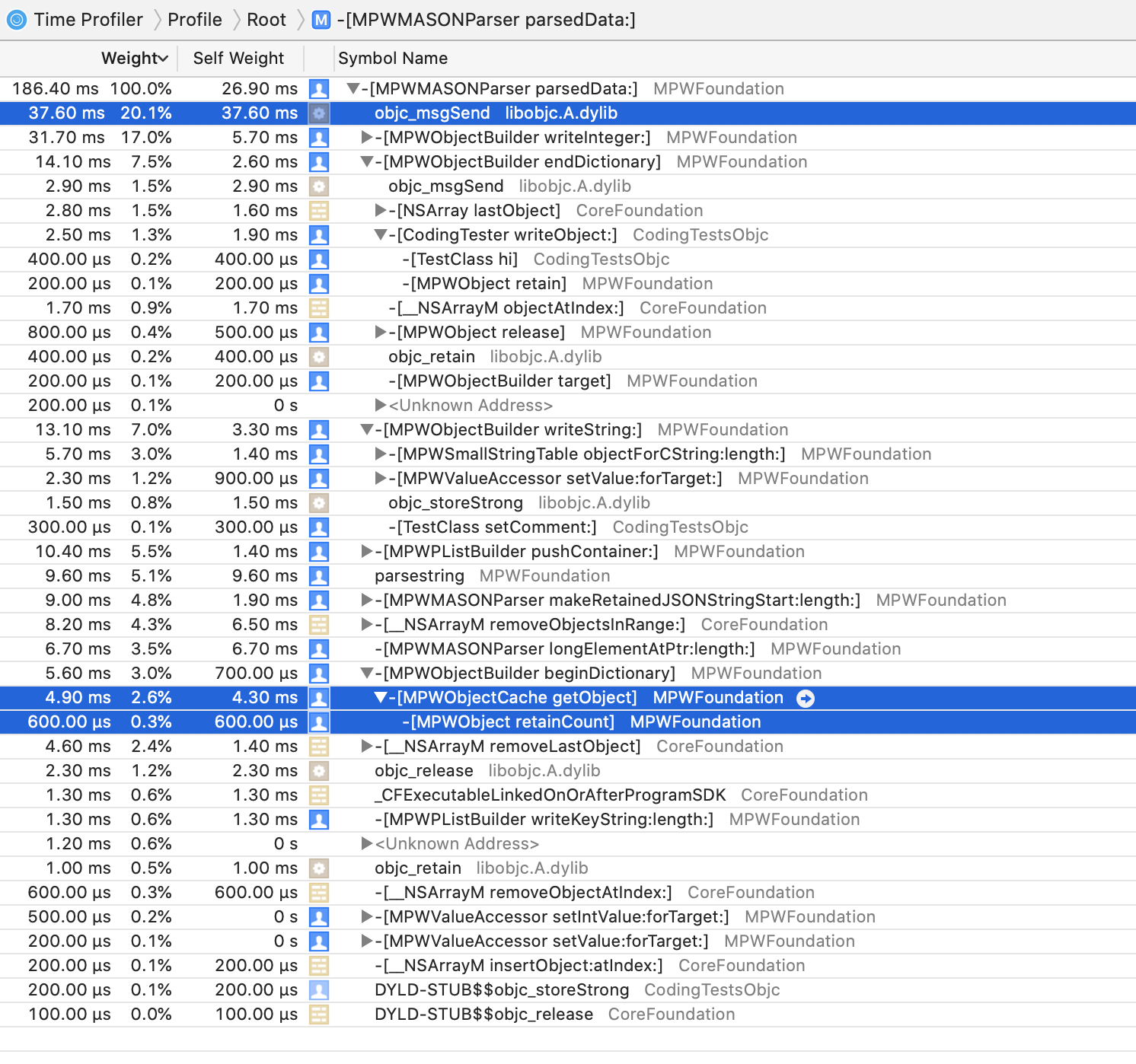
Very well, at 192 ms and 229 MB/s. In addition, the time to first object is around 700 µs, so less than a millisecond for an application to start receiving usable data and be able to provide feedback to the user.

What's immediately noticeable is that the beginDictionary method is no longer at the top of the profile, it is almost all the way to the bottom with just 2.6% and 4.3ms of the total running time.

How is this actually possible? After all, we still get the 1 million objects, so we still have to create all of them, even if we dole them out in a piecemeal fashion. Or do we?

MPWObjectCache

The MPWObjectCache class (.h .m), keeps a circular buffer of objects that it can reinitialize and reuse after the application code is done with them. It is described in some detail in my book (did I mention the book?), in a part that Pearson has kindly made publicly available.

With such a cache in place, we only actually instantiate the number of objects needed to fill the cache, after that we safely recycle those same objects over and over again, at the cost of a few function calls. If objects are retained, they will not be reused.

Column stores, or structures of arrays

Another neat way of interpreting dematerialization is to store all the data in a columnar data format, a structure of arrays (SoA) instead of Array of Structures (AoS) organisation. (Thanks to Holgi for suggesting this).

For this we need a specific builder (MPWArraysBuilder, .h .m) that maintains a set of (mutable) arrays stored by key. When it receives a value, it looks up the appropriate array by key and adds the value to that array, as follows:


-(void)writeInteger:(long)number
{
    if ( _arrayMap && keyStr) {
        MPWIntArray *a=OBJECTFORSTRINGLENGTH(_arrayMap, keyStr, keyLen);
        [a addInteger:(int)number];
        keyStr=NULL;
    }
}

-(void)writeString:(id)aString
{
    if ( _arrayMap && keyStr) {
        NSMutableArray *a=OBJECTFORSTRINGLENGTH(_arrayMap, keyStr, keyLen);
        [a addObject:aString];
        keyStr=NULL;
    }
}

For integer values, this would be an MPWIntArray (.h .m) for strings a regular NSMutableArray.

This does even better, at 155 ms / 284 MB/s.

Other options

These are not the only options. For example, it turns out that the protocol connecting parser and builder was not specifically created for this purpose, it actually extends the Streaming protocol to handle disassembled hierarchies. So you can take a tree, pipe it through a pipeline and then accurately reassemble it on the other end.

The protocol is used in Polymorphic Write Streams to enable Standard Object Out shown at DLS '19, with an earlier version presented at Macoun 2018 (German):

Outlook

However, we are probably hitting diminishing returns at this point, certainly for a proof of concept. There is certainly some more fat to trim, some objc_msgSend()s to IMP-cache away, and going over most of the character input twice is probably something we could avoid.

Apart from further performance improvements, there are also minor details of correctness to take care of, for example handling the JSON escape characters in keys or properly handling hierarchy. These things are not particularly hard, and are handled for XML in the superclass, but do require a bit of thought and effort to complete.

There is also the question of hooking up to Swift in general (a simple attempt failed in getting the right methods), or Codable in particular. The latter would require a somewhat different approach from now: instead of instantiating the object and actively setting its properties, you need to create a temporary structure that you then pass to the object's decoder so it can decode itself. Again, the MAX superclass uses this approach, so it probably won't be too hard to do, with the main trickiness probably in reconciling that more hierarchical/recursive approach with the streaming required by the protocol.

I can (and probably will) also go into a little more analysis of the hows and whys of this approach. So maybe provide some feedback: what would interest you most? Are you interested in a production version of this? Or more extreme optimizations (the ones so far were fairly tame)?

Note

I can help not just Apple, but also you and your company/team with performance and agile coaching, workshops and consulting. Contact me at info at metaobject.com.

TOC

Somewhat Less Lethargic JSON Support for iOS/macOS, Part 1: The Status Quo
Somewhat Less Lethargic JSON Support for iOS/macOS, Part 2: Analysis
Somewhat Less Lethargic JSON Support for iOS/macOS, Part 3: Dematerialization
Equally Lethargic JSON Support for iOS/macOS, Part 4: Our Keys are Small but Legion
Less Lethargic JSON Support for iOS/macOS, Part 5: Cutting out the Middleman
Somewhat Faster JSON Support for iOS/macOS, Part 6: Cutting KVC out of the Loop
Faster JSON Support for iOS/macOS, Part 7: Polishing the Parser
Faster JSON Support for iOS/macOS, Part 8: Dematerialize All the Things!
Beyond Faster JSON Support for iOS/macOS, Part 9: CSV and SQLite

Saturday, December 14, 2019

The Four Stages of Objective-Smalltalk

One of the features that can be confusing about Objective-Smalltalk is that it actually has several parts that are each significant on their own, so frequently will focus on just one of these (which is fine!), but without realising that the other parts also exist, which is unfortunate as they are all valuable and complement each other. In fact, they can be described as stages that are (logically) built on top of each other.

1. WebScript 2 / "Shasta"

Objective-C has always had great integration with other languages, particularly with a plethora of scripting languages, from Tcl to Python and Ruby to Lisp and Scheme and their variants etc. This is due not just to the fact that the runtime is dynamic, but also that it is simple and C-based not just in terms of being implemented in C, but being a peer to C.

However, all of these suffer from having two somewhat disparate languages, with competing object models, runtimes, storage strategies etc. One language that did not have these issues was WebScript, part of WebObjects and essentially Objective-C-Script. The language was interpreted, a peer in which you could even implement categories on existing Objective-C objects, and so syntactically compatible that often you could just copy-paste code between the two. So close to the ideal scripting language for that environment.

However, the fact that Objective-C is already a hybrid with some ugly compromises means that these compromises often no longer make sense at all in the WebScript environment. For example, Objective-C strings need an added "@" character because plain double quotes are already taken by C strings, but there are no C strings in WebScripts. Primitive types like int can be declared, but are really objects, the declaration is a dummy, a NOP. Square brackets for message sends are needed in Objective-C to distinguish messages from the rest of the C syntax, but the that's also irrelevant in WebScript. And so on.

So the first stage of Objective-Smalltalk was/is to have all the good aspects of WebScript, but without the syntactic weirdness needed to match the syntactic weirdness of Objective-C that was needed because Objective-C was jammed into C. I am not the only one who figured out the obvious fact that such a language is, essentially, a variant of Smalltalk, and I do believe this pretty much matches what Brent Simmons called Shasta.

Implementation-wise, this works very similarly to WebScript in that everything in the language is an object and gets converted to/from primitives when sending or receiving messages as needed.

This is great for a much more interactive programming model than what we have/had (and the one we have seems to be deteriorating as we speak):

And not just for isolated fragments, but for interacting with and tweaking full applications as they are running:

2. Objective-C without the C

Of course, getting rid of the (syntactic) weirdnesses of Objective-C in our scripting language means that it is no longer (syntactically) compatible with Objective-C. Which is a shame.

It is a shame because this syntactic equivalence between Objective-C and WebScript meant that you could easily move code between them. Have a script that has become stable and you want to reuse it? Copy and paste that code into an Objective-C file and you're good to go. Need it faster? Same. Have some Objective-C code that you want to explore, create variants of etc? Paste it into WebScript. Such a smooth integration between scripting and "programming" is rare and valuable.

The "obvious" solution is to have a native AOT-compiled version of this scripting language and use it to replace Objective-C. Many if not all other scripting languages have struggled mightily with becoming a compiled language, either not getting there at all or requiring JIT compilers of enormous size, complexity, engineering effort and attack surface.

Since the semantic model of our scripting language ist just Objective-C, we know that we can AOT-compile this language with a fairly straightforward compiler, probably a lot simpler than even the C/Objective-C compilers currently used, and plugging into the existing toolchain. Which is nice.

The idea seems so obvious, but apparently it wasn't.

Everything so far would, taken together, make for a really nice replacement for Objective-C with a much more productive and, let's face it, fun developer experience. However, even given the advantages of a simpler language, smoothly integrated scripting/programming and instant builds, it's not really clear that yet another OO language is really sufficient, for example the Etoilé project or the eero language never went anywhere, despite both being very nice.

3. Beyond just Objects: Architecture Oriented Programming

Ever since my Diplomarbeit, Approaches to Composition and Refinement in Object-Oriented Design back in 1997, I've been interested in Software Architecture and Architecture Description Languages (ADLs) as a way of overcoming the problems we have when constructing larger pieces of software.

One thing I noticed very early is that the elements of an ADL closely match up with and generalise the elements of a programming language, for example an object-oriented language: object generalises to component, message to connector. So it seemed that any specific pogramming language is just a specialisation or instantiation of a more general "architecture language".

To explore this idea, I needed a language that was amenable to experimentation, by being both malleable enough as to allow a metasystem that can abstract away from objects and messages and simple/small enough to make experimentation feasible. A simple variant of Smalltalk would do the trick. More mature variants tend to push you towards building with what is there, rather than abstracting from it, they "...eat their young" (Alan Kay).

So Objective-Smalltalk fits the bill perfectly as a substrate for architecture-oriented programming. In fact, its being built on/with Objective-C, which came into being largely to connect the C/Unix world with the Smalltalk world, means it is already off to a good start.

What to build? How about not reinventing the wheel and simply picking the (arguably) 3 most successful/popular architectural styles:

  • OO (subsuming the other call/return styles)
  • Unix Pipes and Filters
  • REST
Again, surprisingly, at least to me, even these specific styles appear to align reasonably well with the elements we have in a programming language. OO is already well-developed in (Objective-)Smalltalk, dataflow maps to Smalltalk's assignment operator, which needed to be made polymorphic anyway, and REST at least partially maps to non-message identifiers, which also are not polymorphic in Smalltalk.

Having now built all of these abstractions into Objective-Smalltalk, I have to admit again to my surprise how well they work and work together. Yes, it was my thesis, and yes, I can now see confirmation bias everywhere, but it was also a bit of a long-shot.

4. Architecture Oriented Metaprogramming

The architectural styles described above are implemented in frameworks and their interfaces hard-coded into the language implementation. However, with three examples , it should now be feasible to create linguistic support for defining the architectural styles in the language itself, allowing users to define and refine their own architectural styles. This is ongoing work.

What now?

One of the key takeaways from this is that each stage is already quite useful, and probably a worthy project all by itself, it just gets Even Better™ with the addition of later stages. Another is that I need to get back to getting stage ready, as it wasn't actually needed for stage 3, at least not initially.

Thursday, November 14, 2019

Presenting (in) Objective-Smalltalk

2019 has been the year that I have started really talking about Objective-Smalltalk in earnest, because enough of the original vision is now in place.

My first talk was at the European Smalltalk User Group's (ESUG) annual conference in my old hometown of Cologne: (pdf)

This year's ESUG was was my first since Essen in 2001, and it almost seemed like a bit of a timewarp. Although more than half the talks were about Pharo, the subjects seemed mostly the same as back when: a bit of TDD, a bit of trying to deal with native threads (exactly the same issues I struggled with when I was doing the CocoaSqueak VM), a bit of 3D graphics that weren't any better than 3D graphics in other environments, but in Smalltalk.

One big topic was getting large (and very profitable) Smalltalk code-bases running on mobile devices such as iPhones. The top method was transpiling to JavaScript, another translating the VM code to JavaScript and then having that run off-the-shelf images. Objective-Smalltalk can also be put in this class, with a mix of interpretation and native compilation.

My second talk, I was at Germany's oldest Mac conference, Macoun in Frankfurt. The videos from there usually take a while, but here was a reaction:

"Anyone who wants a glimpse at the future should have watched @mpweiher's talk"

Aww, shucks, thanks, but I'll take it. :-)

I also had two papers accepted at SPLASH '19, one was Standard Object Out: Streaming Objects with Polymorphic Write Streams at the Dynamic Languages Symposium, the other was Storage Combinators at Onward!.

Anyway, one aspect of those talks that I didn't dwell on is that the presentations themselves were implemented in Objective-Smalltalk, in fact the definitions were Objective-Smalltalk expressions, complex object literals to be precise.

What follows is an abridged version of the ESUG presentation:


controller := #ASCPresentationViewController{
    #Name : 'ESUG Demo'.
    #Slides : #(

      #ASCChapterSlide { 
               #text : 'Objective-SmallTalk'.
               #subtitle : 'Marcel Weiher (@mpweiher)'
         }  ,

        #ASCBulletSlide{ 
             #title : 'Objective-SmallTalk'.
             #bullets : #( 
                'Embeddable SmallTalk language (Mac, iOS, Linux, Windows)',
                'Objective-C framework (peer/interop)',
                'Generalizes Objects+Messages to Components+Connectors',
                'Enable composition by solving Architectural Mismatch',
             )
        } ,
      #ASCBulletSlide{ 
             #title : 'The Gentle Tyranny of Call/Return'.
             #bullets : #( 
                'Feymnan: we name everything just a little wrong',
                'Multiparadigm: Procedural, OO and FP!',
                "Guy Steele: it's no longer about completion",
                "Oscar Nierstrasz: we were told we could just model the domain",
                "Andrew Black: good OO students antropmorphise the objects",
             )
        } ,

         #ProgramVsSystem { 
              #lightIntensities : #( 0.2 , 0.7 )
              
         }  ,


       #ASCSlideWithFigure{ 
             #delayInSeconds : 5.0.
             #title : 'Objects and Messages'.
             #bullets : #( 
                'Objective-C compatible semantics',
                'Interpreted and native-compiled',
                '"C" using type annotations',
                'Higher Order Messaging',
                'Framework-oriented development',
                'Full platform integration',
             )
        } ,
  

       #ASCBulletSlide{ 
             #title : 'Pipes and Filters'.
             #bullets : #( 
                'Polymorphic Write Streams (DLS ''19)',
                '#writeObject:anObject',
                'Triple Dispatch + Message chaining',
                'Asynchrony-agnostic',
                'Streaming / de-materialized objects',
                'Serialisation, PDF/PS (Squeak), Wunderlist, MS , To Do',
                'Outlook: filters generalise methods?',
            )
        } ,
 
       #ASCBulletSlide{ 
             #title : 'In-Process REST'.
             #bullets : #( 
                'What real large-scale networks use',
                'Polymorphic Identifiers',
                'Stores',
                'Storage Combinators',
                'Used in a number of applications',
             )
        } ,


       #ASCBulletSlide{ 
             #title : 'Polymorphic Identifiers'.
             #bullets : #( 
                'All identifiers are URIs',
                "var:hello := 'World!",
                'file:{env:HOME}/Downloads/site := http://objective.st',
                'slider setValueHolder: ref:var:celsius',
             )
        } ,

       #ASCBulletSlide{ 
             #title : 'Storage Combinators'.
             #bullets : #( 
                'Onward! ''19',
                'Combinator exposes + consumes REST interfaces',
                'Uniform interface (REST) enables pluggability',
                'Narrow, semantically tight interface enables intermediaries',
                '10x productivity/code improvments',
             )
        } ,


      #ImageSlide{ 
               #text : 'Simple Composed Store'.
               #imageURL : '/Users/marcel/Documents/Writing/Dissertation/Papers/StorageCombinators/disk-cache-json-aligned.png'.
               #xOffset : 2.0 .
               #imageScale : 0.8
         }  , 
      #ASCBulletSlide{ 
             #title : 'Outlook'.
             #bullets : #( 
                'Port Stores and Polymorphic Write Streams',
                'Documentation / Sample Code',
                'Improve native compiler',
                'Tooling (Debugger)',
                'You! (http://objective.st)',
             )
        }  ,


      #ASCChapterSlide { 
               #text : 'Q&A   http://objective.st'.
               #subtitle : 'Marcel Weiher (@mpweiher)'
         }  ,
      )
}. 


There are a number of things going on here:
  • Complex object literals
  • A 3D presentation framework
  • Custom behavior via custom classes
  • Framework-oriented programming
Let's look at these in turn.

Complex object literals

Objective-Smalltalk has literals for arrays (really: ordered collections) and dictionaries, like many other languages now. Array literals are taken from Smalltalk, with a hash and round braces: #(). Unlike other Smalltalks, entries are separated via commas, so #( 1,2,3) rather than #( 1 2 3 ). For dictionaries, I borrowed the curly braces from Objective-C, so #{}.

This gives us the ability to specify complex property lists directly in code. A common idiom in Mac/iOS development circles is to initialize objects from property lists, so something like the following:


presentation = [[MyPresentation alloc] initWithDictionary:aDictionary];

All complex object literals really do is add a little bit of syntactic support for this idiom, by noticing that the two respective character at the start of array and dictionay literals give us a space to put a name, a class name, between those two characters:


presentation := #MyPresentation{ ... };

This will parse the text between the curly brackets as a dictionary and then initialize a MyPresentation object with that dictionary using the exact -initWithDictionary: message given above. This may seem like a very minor convenience, and it is, but it actually makes it possible to simply write down objects, rather than having to write code that constructs objects. The difference is subtle but significant.

The benefit becomes more obvious once you have nested structures. A normal plist contains no specific class information, just arrays, dictionaries numbers and strings, and in the Objective-C example, that class information is provided externally, by passing the generic plist to a specific class instance.

(JSON has a similar problem, which is why I still prefer XML for object encoding.)

So either that knowledge must also be provided externally, for example by the implicit knowledge that all substructure is uniform, or custom mechanisms must be devised to encode that information inside the dictionaries or arrays. Ad hoc. Every single time.

Complex object identifiers create a common mechanism for this: each subdictionary or sub-array can be tagged with the class of the object to create, and there is a convenient and distinct syntax to do it.

A 3D presentation framework

One of the really cool wow! effects of Alan Kay's Squeak demos is always when he breaks through the expected boundaries of a presentation with slides and starts live programming and interactive sketching on the slide. The effect is verey similar to when characters break the "fourth wall", and tends to be strongest on the very jaded, who were previously dismissive of the whole presentation.

Alas, a drawback is that those presentations in Squeak tend to look a bit amateurish and cartoonish, not at all polished.

Along came the Apple SceneKit Team's presentations, which were done as Cocoa/SceneKit applications. Which is totally amazing, as it allows arbitrary programmability and integration with custom code, just like Alan's demos, but with a lot more polish.

Of course, an application like that isn't reusable, the effort is pretty high and interactivity low.

I wonder what we could do about that?

First: turn the presentation application into a framework (Slides3D). Second, drive that framework interactively with Objective-Smalltalk from my Workspace-like "Smalltalk" application: presentation.txt. After a bit of setup such as loading the framework (framework:Slides3D load.) and defining a few custom slide classes, it goes on to define the presentation using the literal shown above and then starts the presentation by telling the presentation controller to display itself in a window.


framework:Slides3D load.     
class ProgramVsSystem : ASCSlide {
   var code.
   var system.
   ...
}.
class ImageSlide : ASCSlide { 
     var text.
     var image.


      #ASCChapterSlide { 
               #text : 'Q&A   http://objective.st'.
               #subtitle : 'Marcel Weiher (@mpweiher)'
         }  ,
      )
}. 

controller := #ASCPresentationViewController{
    #Name : 'ESUG Demo'.
    #Slides : #(

      #ASCChapterSlide { 
               #text : 'Objective-SmallTalk'.
               #subtitle : 'Marcel Weiher (@mpweiher)'
         }  ,

       ...
      )
}. 
     
controller view openInWindow:'Objective-SmallTalk (ESUG 2019)'. 

Voilà: highly polished, programmatically driven presentations that I can edit interactively and with a somewhat convenient format. Of course, this is not a one-off for presentations: the same mechanism can be used to define other object hierarchise, including but not limited to interactive GUIs.

Framework-oriented programming

Which brings us to the method behind all this madness: the concept I call framework-oriented programming.

The concept is worth at least another article or two, but at its most basic boils down to: for goodness sake, put the bulk of your code in frameworks, not in an application. Even if all you are building is an application. One app that does this right is Xcode. On my machine, the entire app bundle is close to 10GB. But the actual Xcode binary in /Applications/Xcode.app/Contents/MacOS? 41KB. Yes, Kilobytes. And most of that is bookkeeping and boilerplate, it really just contains a C main() function, which I presume largely matches the one that Xcode generates.

Why?

Simple: an Apple framework (i.e.: a .framework bundle) is at least superficially composable, but a .app bundle is not. You can compose frameworks into bigger frameworks, and you can take a framework and use it in a different app. This is difficult to impossible with apps (and no, kludged-together AppleScript concoctions don't count).

And doing it is completely trivial: after you create an app project, just create a framework target alongside the app target, add that framework to the app and then add all code and resources to the framework target instead of to the app target. Except for the main() function. If you already have an app, just move the code to the framework target, making adjustments to bundle loading code (the relevant bundle is now the framework and no longer the app/main bundle). This is what I did to derive Slides3D from the WWDC 2013 SceneKit App.

What I've described so fa is just code packaging. If you also organize the actual code as an object-oriented framework, you will notice that with time it will evolve into a black-box framework, with objects that are created, configured and composed. This is somewhat tedious to do in the base language (see: creating Views programmatically), so the final evolutionary step is considered a DSL (Hello, SwiftUI!). However, most of this DSL tends to be just creating, configuring and connecting objects. In other words: complex object literals.

Monday, November 11, 2019

What Alan Kay Got Wrong About Objects

One of the anonymous reviewers of my recently published Storage Combinators paper (pdf) complained that hiding disk-based, remote, and local abstractions behind a common interface was a bad idea, citing Jim Waldo's A Note on Distributed Computing.

Having read both this and the related 8 Fallacies of Distributed Computing a while back, I didn't see how this would apply, and re-reading confirmed my vague recollections: these are about the problems of scaling things up from the local case to the distributed case, whereas Storage Combinators and In-Process REST are about scaling things down from the distributed case to the local case. Particularly the Waldo paper is also very specifically about objects and messages, REST is a different beast.

And of course scaling things down happens to be time-honored tradtition with a pretty good track record:

In computer terms, Smalltalk is a recursion on the notion of computer itself. Instead of dividing "computer stuff" into things each less strong than the whole—like data structures, procedures, and functions which are the usual paraphernalia of programming languages—each Smalltalk object is a recursion on the entire possibilities of the computer. Thus its semantics are a bit like having thousands and thousands of computers all hooked together by a very fast network.
Mind you, I think this is absolutely brilliant: in order to get something that will scale up, you simply start with something large and then scale it down!.

But of course, this actually did not happen. As we all experienced scaling local objects and messaging up to the distributed case did not (CORBA, SOAP,...), and as Waldo explains, cannot, in fact, work. What gives?

My guess is that the method described wasn't actually used: when Alan came up with his version of objects, there were no networks with thousands of computers. And so Alan could not actually look at how they communicated, he had to imagine it, it was a Gedankenexperiment. And thus objects and messages were not a scaled-down version of an actual larger thing, they were a scaled down version of an imagined larger thing.

Today, we do have a large network of computers, with not just thousands but billions of nodes. And they communicate via HTTP using the REST architectural style, not via distributed objects and messages.

So maybe if we took that communication model and scaled it down, we might be able to do even better than objects and messages, which already did pretty brilliantly. Hence In-Process REST, Polymorphic Identifiers and Storage Combinators, and yes, the results look pretty good so far!

The big idea is "messaging" -- that is what the kernal of Smalltalk/Squeak is all about (and it's something that was never quite completed in our Xerox PARC phase). The Japanese have a small word -- ma -- for "that which is in between" -- perhaps the nearest English equivalent is "interstitial". The key in making great and growable systems is much more to design how its modules communicate rather than what their internal properties and behaviors should be. Think of the internet -- to live, it (a) has to allow many different kinds of ideas and realizations that are beyond any single standard and (b) to allow varying degrees of safe interoperability between these ideas.

So of course Alan is right after all, just not about objects and messages, which are too specific: "ma", or "interstitialness" or "connector" is the big idea, messaging is just one incarnation of that idea.

Thursday, November 7, 2019

Instant Builds

One of the goals I am aiming for in Objective-Smalltalk is instant builds and effective live programming.

A month ago, I got a package from an old school friend: my old Apple ][+, which I thought I had given as a gift, but he insisted had been a long-term loan. That machine featured 48KB of DRAM and a 1 MHz, 8 bit 6502 processor that took multiple cycles for even the simplest instructions, had no multiply instructions and almost no registers. Yet, when I turn it on it becomes interactive faster than the CRT warms up, and the programming experience remains fully interactive after that. I type something in, it executes. I change the program, type "RUN" and off it goes.

Of course, you can also get that experience with more complex systems, Smalltalk comes to mind, but the point is that it doesn't take the most advanced technology or heroic effort to make systems interactive, what it takes is making it a priority.


But here we are indeed.

Now Swift is only one example of this, it's a current trend, and of course these systems do claim that they provide benefits that are worth the wait. From optimizations to static type-checking with type-inference, so that "once it compiles, it works". This is deemed to be (a) 100% worthwhile despite the fact that there is no scientific evidence backing up these claims (a paper which claimed that it had the evidence was just shredded at this year's OOPSLA) and (b) essentially cost-free. But of course it isn't cost free:

So when everyone zigs, I zag, it's my contrarian nature. Where Swift's message was, essentially "there is too much Smalltalk in Objective-C", my contention is that there is too little Smalltalk in Objective-C (and also that there is too little "Objective" in Smalltalk, but that's a different topic).

Smalltalk was perfectly interactive in its own environment on high end late 70s and early 80s hardware. With today's monsters of computation, there is no good reason, or excuse for that matter, to not be interactive even when taken into the slightly more demanding Unix/macOS/iOS development world. That doesn't mean there aren't loads of reasons, they're just not any good.

So Objective-Smalltalk will be fast, it will be live or near-live at all times, and it will have instant builds. This isn't going to be rocket science, mostly, the ingredients are as follows:

  1. An interpreter
  2. Late binding
  3. Separate compilation
  4. A fast and simple native compiler
Let's look at these in detail.

An interpreter

The basic implementation of Objective-Smalltalk is an AST-walking interpreter. No JIT, not even a simple bytecode interpreter. Which is about as pessimal as possible, but our machines are so incredibly fast, and a lot of our tasks simple enough or computational steering enough that it actually does a decent enough job for many of those tasks. (For more on this dynamic, see The Death of Optimizing Compilers by Daniel J. Bernstein)

And because it is just an interpreter, it has no problems doing its thing on iOS:

(Yes, this is in the simulator, but it works the same on an actual device)

Late Binding

Late binding nicely decouples the parts of our software. This means that the compiler has very little information about what happens and can't help a lot in terms of optimization or checking, something that always drove the compiler folks a little nuts ("but we want to help and there's so much we could do"). It enables strong modularity and separate compilation. Objective-Smalltalk is as late-bound in its messaging as Objective-C or Smalltalk are, but goes beyond them by also late-binding identifiers, storage and dataflow with Polymorphic Identifiers (ACM, pdf), Storage Combinators (ACM, pdf) and Polymorphic Write Streams (ACM, pdf).

Allowing this level of flexibility while still not requiring a Graal-level Helden-JIT to burn away all the abstractions at runtime will require careful design of the meta-level boundaries, but I think the technically desirable boundaries align very well with the conceptually desirable boundaries: use meta-level facilities to define the language you want to program in, then write your program.

It's not making these boundaries clear and freely mixing meta-level and base-level programming that gets us in not just conceptual trouble, but also into the kinds of technical trouble that the Heldencompilers and Helden-JITs have to bail us out of.

Separate Compilation

When you have good module boundaries, you can get separate compilation, meaning a change in file (or other code-containing entity if you don't like files) does not require changes to other files. Smalltalk had this. Unix-style C programming had this, and the concept of binary libraries (with the generalization to frameworks on macOS etc.). For some reason, this has taken more and more of a back-seat in macOS and iOS development, with full source inclusion and full builds becoming the norm in the community (see CocoaPods) and for a long time being enforced by Apple by not allowing user-define dynamic libraries on iOS.

While Swift allows separate compilation, this can have such severe negative effects on both performance and compile times that compiling everything on any change has become a "best practice". In fact, we now have a build option "whole module optimization with optimizations turned off" for debugging. I kid you not.

Objective-Smalltalk is designed to enable "Framework-oriented-programming", so separate compilation is and will remain a top priority.

A fast and simple native compiler

However, even with an interpreter for interactive adjustments, separate compilation due to good modularity and late binding, you sometimes want to do a full build, or need to rebuild a large part of the codebase.

Even that shouldn't take forever, and in fact it doesn't need to. I am totally with Jonathan Blow on this subject when he says that compiling a medium size project shouldn't really more than a second or so.

My current approach for getting there is using TinyCC's backend as the starting point of the backend for Objective-Smalltalk. After all, the semantics are (mostly) Objective-C and Objective-C's semantics are just C. What I really like about tcc is that it goes so brutally directly to outputting CPU opcode as binary bytes.


static void gcall_or_jmp(int is_jmp)
{
    int r;
    if ((vtop->r & (VT_VALMASK | VT_LVAL)) == VT_CONST &&
	((vtop->r & VT_SYM) && (vtop->c.i-4) == (int)(vtop->c.i-4))) {
        /* constant symbolic case -> simple relocation */
        greloca(cur_text_section, vtop->sym, ind + 1, R_X86_64_PLT32, (int)(vtop->c.i-4));
        oad(0xe8 + is_jmp, 0); /* call/jmp im */
    } else {
        /* otherwise, indirect call */
        r = TREG_R11;
        load(r, vtop);
        o(0x41); /* REX */
        o(0xff); /* call/jmp *r */
        o(0xd0 + REG_VALUE(r) + (is_jmp << 4));
    }
}

No layers of malloc()ed intermediate representations here! This aligns very nicely with the streaming/messaging approach to high-performance I've taken elsewhere with Polymorphic Write Streams (see above), so I am pretty confident I can make this (a) work and (b) simple/elegant while keeping it (c) fast.

How fast? I obviously don't know yet, but tcc is a fantastic starting point. The following is the current (=wrong) ObjectiveTcc code to drive tcc to build a function that sends a single message:


-(void)generateMessageSendTestFunctionWithName:(char*)name
{
    SEL flagMsg=@selector(setMsgFlag);
    [self functionOnlyWithName:name returnType:VT_INT argTypes:"" body:^{
        [self pushFunctionPointer:objc_msgSend];
        [self pushObject:self];
        [self pushPointer:flagMsg];
        [self call:2];
    }];
}

How often can I do this in one second? On my 2018 high spec but 13" MBP: 300,000 times. Including in-memory linking (though not much of that happening in this example), not including Mach-O generation as that's not implemented yet and writing the whole shebang to disk. I don't anticipate either of these taking appreciably additional time.

If we consider this 2 "lines" of code, one for the function/method header and one for the message, then we can generate binary for 600KLOC/s. So having a medium size program compile and link in about a second or so seems eminently doable, even if I manage to slow the raw Tcc performance down by about an order of magnitude.

(For comparison: the Swift code base that motivated the Rome caching system for Carthage was clocking in at around 60 lines per second with the then Swift compiler. So even with an anticipated order of magnitude slowdown we'd still be 1000x faster. 1000x is good enough, it's the difference between 3 seconds and an hour.)

What's the downside? Tcc doesn't do a lot of optimization. But that's OK as (a) the sorts of optimizations C compilers and backends like LLVM do aren't much use for highly polymorphic and late-bound code and (b) the basics get you around 80% of the way (c) most code doesn't need that much optimization (see above) and (d) machines have become really fast.

And it helps that we aren't doing crazy things like initially allocating function-local variables on the heap or doing function argument copying via vtables that require require leaning on the optimizer to get adequate performance (as in: not 100x slower..).

Defense in Depth

While any of these techniques might be adequate some of the time, it's the combination that I think will make the Objective-Smalltalk tooling a refreshing, pleasant and highly productive alternative to existing toolchains, because it will be reliably fast under all circumstances.

And it doesn't really take (much) rocket science, just a willingness to make this aspect a priority.